
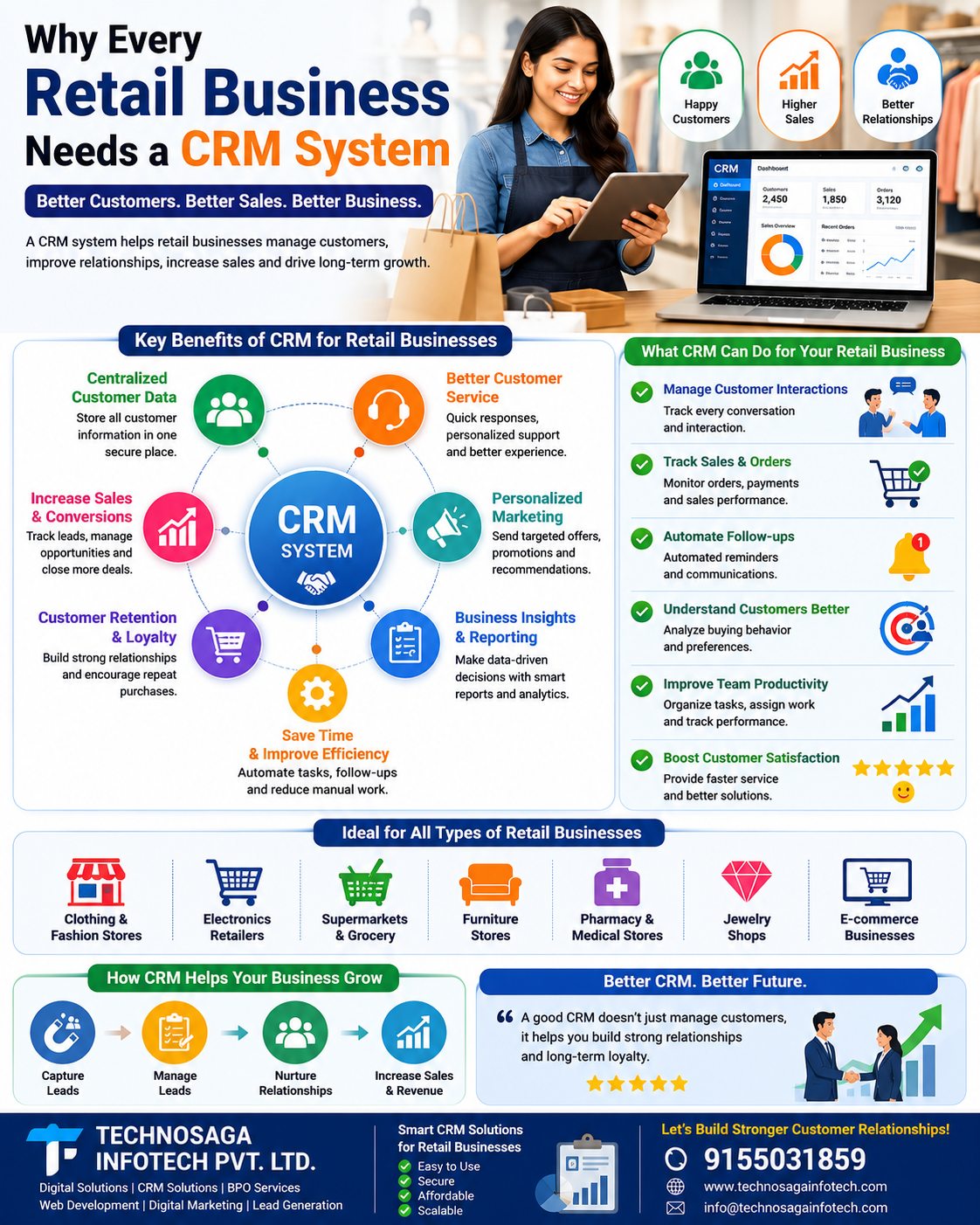
Why Every Retail Business Needs a CRM System
The retail industry has become more competitive than ever. Customers now expect personalized shopping experiences, quick responses, seamless communication, and excellent after-sales support. Managing all this manually can be difficult, especially as your business grows.
This is where a Customer Relationship Management (CRM) system becomes a game-changer. A CRM helps retail businesses organize customer information, manage sales, automate follow-ups, and build long-lasting customer relationships.
Whether you own a clothing store, electronics shop, supermarket, furniture business, pharmacy, or online retail store, implementing a CRM system can significantly improve customer satisfaction and increase revenue.
What is a CRM System?
A Customer Relationship Management (CRM) system is software that helps businesses manage customer interactions, sales opportunities, customer support, marketing campaigns, and business data from a single platform.
Instead of maintaining spreadsheets or handwritten records, businesses can store and access customer information securely and efficiently.
Why Retail Businesses Need a CRM System
1. Centralized Customer Information
A CRM stores all customer details in one place, including:
- Customer Names
- Phone Numbers
- Email Addresses
- Purchase History
- Preferences
- Support Requests
This makes it easier for staff to provide personalized service.
2. Better Customer Service
With instant access to customer history, employees can quickly resolve issues, answer questions, and provide relevant recommendations.
Excellent customer service increases trust and encourages repeat business.
3. Increased Customer Retention
Acquiring a new customer is often more expensive than retaining an existing one.
A CRM helps businesses stay connected with customers through personalized follow-ups, promotional offers, loyalty programs, and reminders.
4. Improved Sales Management
CRM systems track leads, sales opportunities, quotations, and completed transactions.
Managers can monitor sales performance and identify opportunities to increase revenue.
5. Personalized Marketing Campaigns
Retail businesses can use customer purchase history to send personalized promotions, festival offers, birthday discounts, and product recommendations.
Personalized marketing significantly improves conversion rates.
6. Better Inventory Planning
Customer buying patterns help businesses understand demand and plan inventory more effectively.
This reduces stock shortages and excess inventory.
7. Automated Follow-Ups
Modern CRM systems can automate:
- Order Confirmations
- Payment Reminders
- Service Notifications
- Promotional Messages
- Customer Feedback Requests
Automation saves time while improving customer engagement.
8. Business Insights and Reporting
CRM software provides valuable reports on:
- Sales Performance
- Customer Retention
- Top Products
- Marketing Campaign Results
- Revenue Trends
These insights help businesses make better strategic decisions.
Benefits of CRM for Retail Businesses
- Improved customer relationships
- Higher customer retention
- Better sales management
- Increased repeat purchases
- Personalized customer experiences
- Faster customer support
- Improved team productivity
- Better business decision-making
Industries That Benefit from CRM Systems
- Fashion & Apparel Stores
- Electronics Retailers
- Supermarkets
- Furniture Stores
- Medical Stores
- Jewelry Shops
- Automobile Dealers
- E-commerce Businesses
CRM + Digital Marketing = Higher Sales
A CRM becomes even more powerful when integrated with digital marketing strategies such as SEO, Google Ads, social media campaigns, email marketing, and WhatsApp marketing.
Businesses can capture leads online, store them automatically in the CRM, and nurture them until they become loyal customers.
CRM with Professional Customer Support
Retail businesses receiving high volumes of customer inquiries can combine CRM software with professional customer support services.
Partnering with a trusted BPO Company in Patna ensures that customer inquiries, telecalling, lead follow-ups, and support requests are managed efficiently while all interactions are recorded in the CRM.
Best Practices for CRM Success
- Keep customer information updated
- Train employees to use the CRM effectively
- Automate repetitive tasks
- Monitor customer feedback
- Analyze reports regularly
- Integrate CRM with your website and marketing channels
Conclusion
A CRM system is no longer a luxury for retail businesses—it's a necessity. It helps improve customer relationships, streamline operations, increase sales, and deliver personalized shopping experiences.
Businesses that invest in CRM technology today are better equipped to compete, retain customers, and achieve long-term growth.
Technosaga Infotech Pvt. Ltd. provides CRM Solutions, Website Development, Digital Marketing, WhatsApp Automation, Business Process Automation, and BPO Services in Patna to help businesses improve customer engagement and accelerate growth.
Facebook & LinkedIn don't allow pre-filled posts — clicking those buttons copies a ready caption to your clipboard, just paste it (Ctrl+V) into the box that opens.
Sabse pehle comment karne wale bane!