
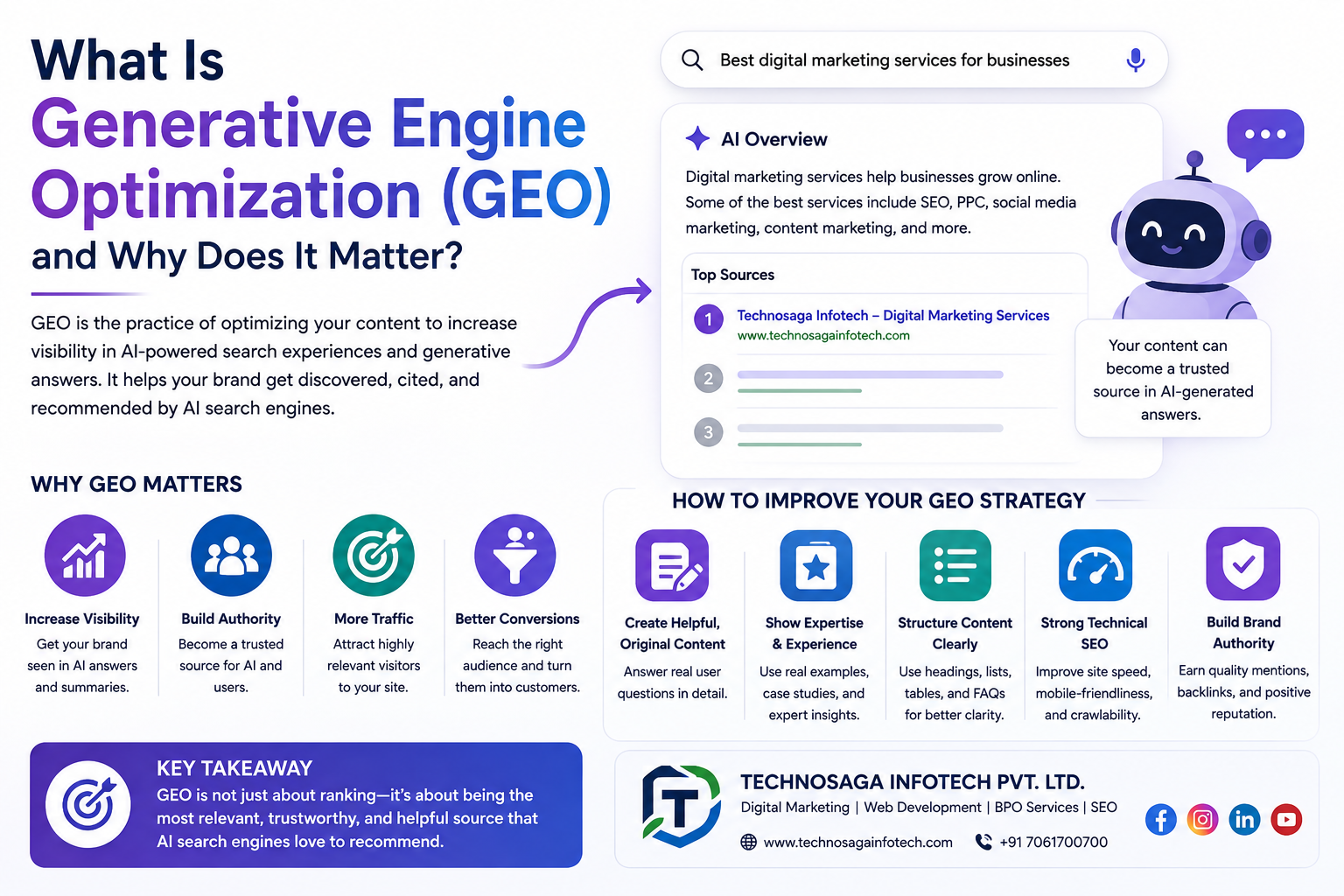
What Is Generative Engine Optimization (GEO) and Why Does It Matter?
Search is changing rapidly. People are no longer relying only on traditional search engine result pages to find information. AI-powered experiences such as Google's AI Overviews and AI Mode can provide synthesized answers and links to relevant websites, creating new opportunities for businesses to become visible during the search journey.
This shift has led to growing interest in Generative Engine Optimization (GEO). GEO generally refers to efforts aimed at improving a brand's visibility in generative AI and AI-powered search experiences.
However, GEO should not be treated as a replacement for SEO. Google states that its generative AI search experiences continue to rely on foundational SEO and Search quality systems.
What Is Generative Engine Optimization?
Generative Engine Optimization, or GEO, is a term used to describe strategies designed to help a business's content become more discoverable and useful within AI-powered search experiences.
When users ask AI-powered search systems complex questions, these systems may retrieve information from multiple web sources before generating a response. Google's documentation describes techniques such as retrieval-augmented generation and query fan-out as part of its generative search systems.
For businesses, this means that simply ranking for individual keywords is no longer the only consideration. Creating authoritative, useful, accessible, and well-structured content can help your website participate in this evolving search ecosystem.
Why Does GEO Matter in 2026?
1. Search Behavior Is Changing
Users are increasingly asking longer and more conversational questions. Instead of searching for a few keywords, they may ask an AI-powered search engine to compare services, explain a problem, recommend solutions, or summarize an industry topic.
This creates opportunities for businesses that publish detailed content capable of answering real customer questions.
2. AI Search Can Surface Multiple Sources
AI-powered search experiences can use information from multiple web pages to construct an answer and may provide links to supporting sources.
This means businesses can potentially gain visibility even when users interact with an AI-generated search experience rather than a traditional list of search results.
3. SEO Still Matters
One of the most important points businesses should understand is that GEO does not mean abandoning SEO.
Google's current guidance explicitly states that existing SEO best practices remain relevant for generative AI search because these experiences are built on Google's core Search systems.
How GEO Works
AI-powered search systems need reliable information that they can discover, understand, and use to answer questions.
A strong GEO strategy therefore focuses on several fundamentals:
- Creating helpful and original content
- Demonstrating genuine expertise
- Answering customer questions clearly
- Maintaining strong technical SEO
- Making content accessible to search engines
- Building brand authority
- Using clear website structures
- Keeping important information accurate and updated
7 Ways to Improve Your GEO Strategy
1. Create Original, Helpful Content
AI systems have access to large amounts of information. Simply rewriting content that already exists online may provide little additional value.
Instead, create content based on your expertise, customer experience, original research, case studies, examples, and unique insights.
Google recommends creating unique, useful, reliable, people-first content rather than producing large amounts of repetitive or commodity content.
2. Answer Real Customer Questions
Think about the questions your customers ask before contacting your business.
Create dedicated content around topics such as:
- What does your service include?
- How much does the service cost?
- How does the process work?
- What are the benefits?
- How should customers compare different solutions?
- What mistakes should customers avoid?
3. Demonstrate Expertise
Businesses should showcase real experience instead of publishing generic information.
Case studies, project examples, expert opinions, original data, customer success stories, and detailed service explanations can make your content more useful and distinctive.
4. Maintain Strong Technical SEO
Your content needs to be accessible to search engines before it can be considered for search visibility.
Make sure your website has:
- Crawlable pages
- Indexable content
- Clear internal links
- Mobile-friendly design
- Fast page performance
- Logical site structure
- Accurate metadata
Google states that pages need to meet the normal technical requirements for Search and be eligible for indexing to be considered for AI search features.
5. Use Clear Content Structure
Organize articles with descriptive headings, short paragraphs, lists, tables where useful, and clear explanations.
This improves readability for people while also making the information easier for search systems to understand.
6. Build Brand Authority
Businesses should develop a consistent presence across their website and relevant online channels.
Publish useful resources, showcase customer success, maintain accurate business information, and build genuine industry recognition rather than attempting to manufacture mentions.
7. Keep Content Updated
Outdated information can reduce the usefulness of a page. Review important content regularly and update statistics, services, examples, screenshots, processes, and other information when necessary.
GEO vs SEO
| SEO | GEO |
|---|---|
| Focuses on visibility in search engines | Focuses on visibility in generative AI search experiences |
| Targets traditional search results | Targets AI-generated answers and supporting links |
| Uses technical, content, and authority strategies | Builds on many of the same SEO fundamentals |
| Focuses heavily on search intent and rankings | Focuses on being useful and relevant within AI-driven search journeys |
It is important to understand that these are not completely separate disciplines. Google describes GEO and AEO as terms used for work focused on AI search visibility, while emphasizing that optimizing for generative AI search is still fundamentally part of optimizing the search experience.
What Businesses Should Not Do
As interest in GEO grows, businesses may encounter claims about special techniques that supposedly guarantee AI visibility. Many of these claims are not supported by Google's official guidance.
- Do not create large volumes of low-value AI-generated pages.
- Do not create content solely to manipulate AI responses.
- Do not rely on keyword stuffing.
- Do not pursue artificial online mentions.
- Do not assume that special AI files or markup are required for Google Search.
Google specifically says there is no special schema markup or AI text file required to appear in its AI search features, and it recommends focusing on useful content and established SEO best practices instead.
Can AI-Generated Content Be Used for GEO?
AI tools can be useful for research, brainstorming, outlining, and improving workflows. However, businesses should not simply publish large volumes of automatically generated content without adding meaningful value.
Google's guidance emphasizes accuracy, quality, relevance, and compliance with Search policies when generative AI is used to create website content.
The best approach is to combine AI-assisted workflows with human expertise, original insights, fact-checking, editing, and a clear understanding of your audience.
How to Measure GEO Performance
Measuring visibility in AI search is still evolving. Businesses should monitor traditional SEO metrics alongside traffic, engagement, conversions, and visibility in AI-powered search experiences.
Google announced dedicated Search Generative AI performance reports in Search Console in June 2026, with reporting for visibility in generative AI features such as AI Overviews and AI Mode being rolled out to a subset of websites.
Businesses should continue monitoring:
- Organic traffic
- Search impressions
- Search queries
- Website conversions
- Engagement
- Lead generation
- Visibility in AI search experiences
GEO and Digital Marketing
GEO should be part of a broader digital marketing strategy rather than a standalone tactic.
Businesses can combine SEO, content marketing, social media, Google Ads, website optimization, CRM, and lead generation to create a complete digital customer journey.
Once AI search and other digital channels generate inquiries, professional telecalling and customer support can help businesses follow up with prospects and convert them into customers. A trusted BPO Company in Patna can support businesses with telecalling, customer support, lead follow-ups, and back-office operations.
Conclusion
Generative Engine Optimization represents an important evolution in the way businesses think about online visibility. As users increasingly interact with AI-powered search experiences, businesses need to focus on creating content that is useful, original, trustworthy, technically accessible, and genuinely valuable to their audience.
However, GEO is not a shortcut around SEO. The strongest strategy is to build a technically sound website, follow established SEO principles, publish original expert-led content, maintain strong user experience, and continuously improve based on customer needs.
Technosaga Infotech Pvt. Ltd. provides SEO, Generative Engine Optimization, Content Marketing, Website Development, Google Ads, Meta Ads, Lead Generation, CRM Solutions, and BPO Services in Patna to help businesses build stronger digital visibility and generate sustainable growth.
Facebook & LinkedIn don't allow pre-filled posts — clicking those buttons copies a ready caption to your clipboard, just paste it (Ctrl+V) into the box that opens.
Sabse pehle comment karne wale bane!