
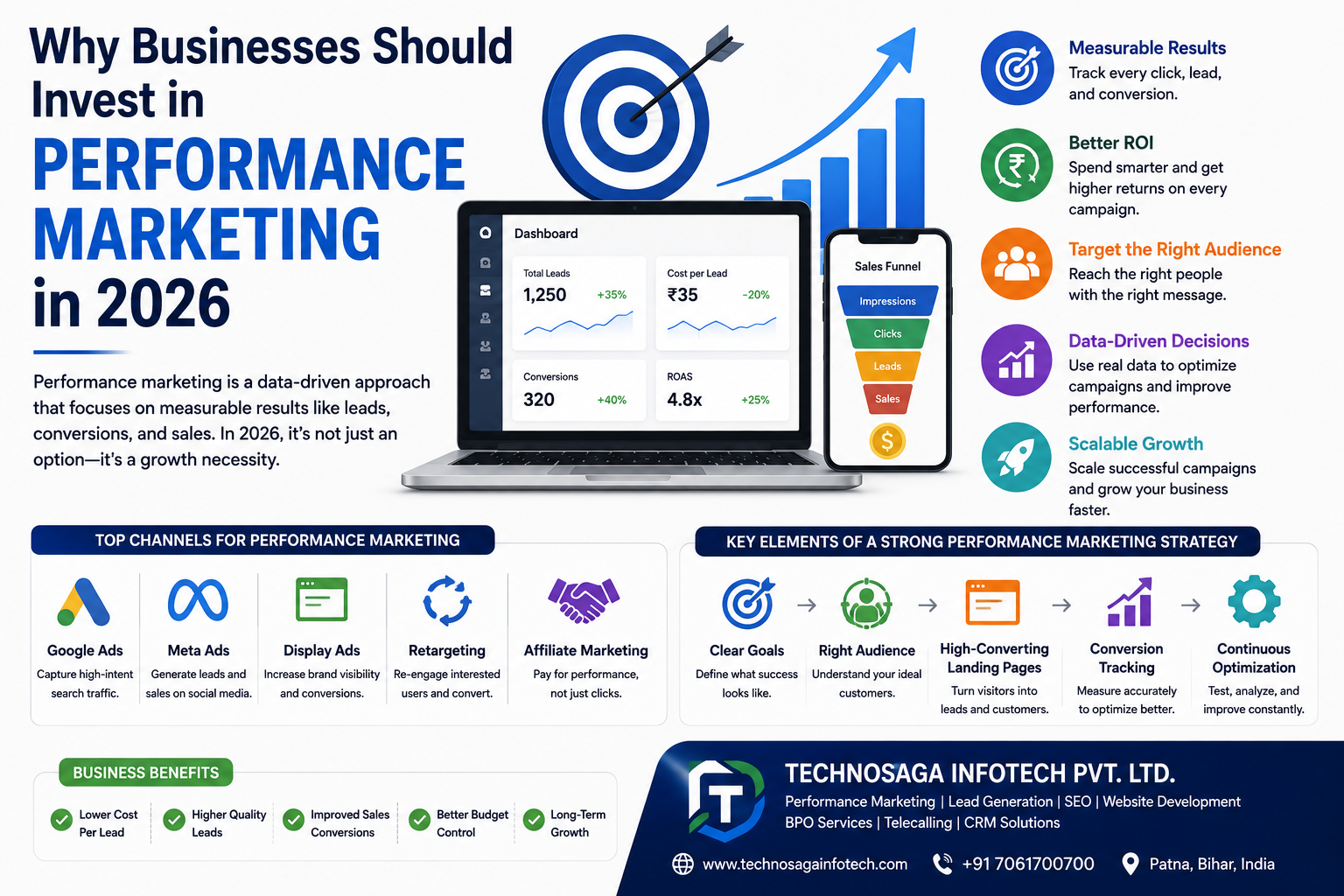
Why Businesses Should Invest in Performance Marketing in 2026
Digital marketing has become more competitive than ever. Businesses are investing in Google Ads, Meta Ads, SEO, social media, content, and other digital channels to reach potential customers. However, simply spending money on advertising is not enough. Businesses need to understand what their marketing investment is generating.
This is where performance marketing becomes important.
Performance marketing is a data-driven approach where businesses focus on measurable outcomes such as leads, sales, conversions, customer acquisition, and revenue. Instead of evaluating campaigns only by impressions or clicks, businesses can analyze actual performance and continuously optimize their marketing investment.
What Is Performance Marketing?
Performance marketing is a digital marketing approach focused on measurable results. Campaigns can be tracked using metrics such as Cost Per Lead (CPL), Cost Per Acquisition (CPA), Conversion Rate, Return on Ad Spend (ROAS), and Customer Acquisition Cost (CAC).
Common performance marketing channels include:
- Google Ads
- Meta Ads
- Search Advertising
- Display Advertising
- Remarketing
- Affiliate Marketing
- Lead Generation Campaigns
- Conversion Rate Optimization
Why Performance Marketing Matters in 2026
1. Every Marketing Rupee Needs to Be Accountable
Businesses want to know where their marketing budget is going and what results it is generating.
Performance marketing allows businesses to monitor campaign metrics and identify which channels, audiences, creatives, and landing pages are producing better results.
2. Better Control Over Advertising Budgets
Performance campaigns can be monitored continuously. If a campaign or audience is not performing as expected, marketers can adjust targeting, creatives, bidding strategies, landing pages, or budgets.
This flexibility helps businesses avoid continuing to spend heavily on underperforming campaigns.
3. Data-Driven Decision Making
Instead of relying entirely on assumptions, businesses can use campaign data to understand customer behavior.
Performance marketing helps answer questions such as:
- Which audience converts best?
- Which advertisement generates more leads?
- Which landing page has a better conversion rate?
- Which channel produces the lowest qualified lead cost?
- Which campaigns generate actual sales?
4. Faster Testing and Optimization
Digital campaigns can be tested and optimized relatively quickly. Marketers can experiment with different headlines, creatives, audiences, offers, landing pages, and calls-to-action.
The results can then be used to improve future campaigns.
5. Better Lead Generation
Performance marketing can help businesses target people who are more likely to be interested in their products or services.
For example, a business can run lead-generation campaigns on Google or Meta and track how many inquiries are generated from different campaigns.
6. Supports Business Growth
Once a campaign consistently produces profitable results, businesses can gradually scale it by increasing budgets, expanding audiences, testing new creatives, or entering new markets.
This makes performance marketing particularly useful for businesses looking for measurable and scalable customer acquisition.
Performance Marketing vs Traditional Marketing
| Performance Marketing | Traditional Marketing |
|---|---|
| Highly measurable | Often harder to attribute precisely |
| Uses real-time campaign data | May rely more heavily on estimated reach |
| Allows continuous optimization | Campaign changes can be slower |
| Tracks leads, conversions, and sales | Often focuses on awareness and reach |
| Flexible digital targeting | May use broader audience targeting |
Key Performance Marketing Metrics
Businesses should track the metrics that are most relevant to their objectives.
- Cost Per Lead (CPL): The average amount spent to generate a lead.
- Cost Per Acquisition (CPA): The cost of acquiring a customer or desired conversion.
- Conversion Rate: The percentage of visitors or leads who complete a desired action.
- Return on Ad Spend (ROAS): Revenue generated in relation to advertising spend.
- Customer Acquisition Cost (CAC): The overall cost of acquiring a customer.
- Lead-to-Customer Rate: The percentage of leads that become customers.
Google Ads and Meta Ads in Performance Marketing
Google Ads can help businesses reach people actively searching for products and services, while Meta Ads can help businesses reach audiences based on interests, behaviors, demographics, and other targeting signals.
Using both channels can provide businesses with opportunities to capture existing demand while also creating new demand.
Performance Marketing Requires More Than Running Ads
Running advertisements is only one part of a successful performance marketing strategy.
Businesses also need:
- High-converting landing pages
- Accurate conversion tracking
- Strong ad creatives
- Relevant audience targeting
- Clear offers
- Fast lead follow-up
- CRM integration
- Regular campaign optimization
A campaign can generate inexpensive leads but still fail to produce business results if the leads are poor quality or are not followed up properly.
Why Lead Quality Matters
Businesses should not focus only on getting the lowest possible CPL. A low-cost lead has little value if that lead has no genuine interest in the product or service.
Performance marketing should therefore focus on the complete customer journey—from advertisement and landing page to lead qualification, sales follow-up, and final conversion.
Combining Performance Marketing With Lead Follow-Up
Once a campaign generates leads, fast and professional follow-up can significantly improve the chances of conversion.
Businesses can use CRM systems, WhatsApp automation, email marketing, and professional telecalling to manage and nurture leads.
A trusted BPO Company in Patna can support businesses with lead follow-up, outbound calling, customer support, appointment setting, and telecalling services.
How to Build a Performance Marketing Strategy in 2026
- Define clear business objectives.
- Identify your target audience.
- Choose the right advertising channels.
- Create compelling ad creatives.
- Build dedicated landing pages.
- Set up conversion tracking.
- Launch campaigns with controlled budgets.
- Monitor lead quality and conversion data.
- Optimize campaigns based on performance.
- Scale campaigns that consistently deliver profitable results.
Benefits of Performance Marketing
- Measurable marketing results
- Better budget control
- Data-driven decisions
- Improved lead generation
- Flexible campaign optimization
- Better audience targeting
- Scalable customer acquisition
- Greater visibility into marketing performance
Conclusion
In 2026, businesses need more than visibility—they need measurable business outcomes. Performance marketing provides a structured approach to digital advertising by connecting marketing investment with measurable actions such as leads, conversions, customers, and revenue.
However, successful performance marketing requires more than simply running Google or Meta Ads. Businesses need strong creatives, accurate tracking, optimized landing pages, quality lead generation, and consistent follow-up.
By combining performance marketing with CRM, automation, SEO, website optimization, and professional customer communication, businesses can build a more efficient and scalable customer acquisition system.
Technosaga Infotech Pvt. Ltd. provides Performance Marketing, Google Ads, Meta Ads, SEO, Lead Generation, Website Development, CRM Solutions, WhatsApp Automation, Telecalling, and BPO Services in Patna to help businesses achieve measurable digital growth.
Facebook & LinkedIn don't allow pre-filled posts — clicking those buttons copies a ready caption to your clipboard, just paste it (Ctrl+V) into the box that opens.
Sabse pehle comment karne wale bane!