
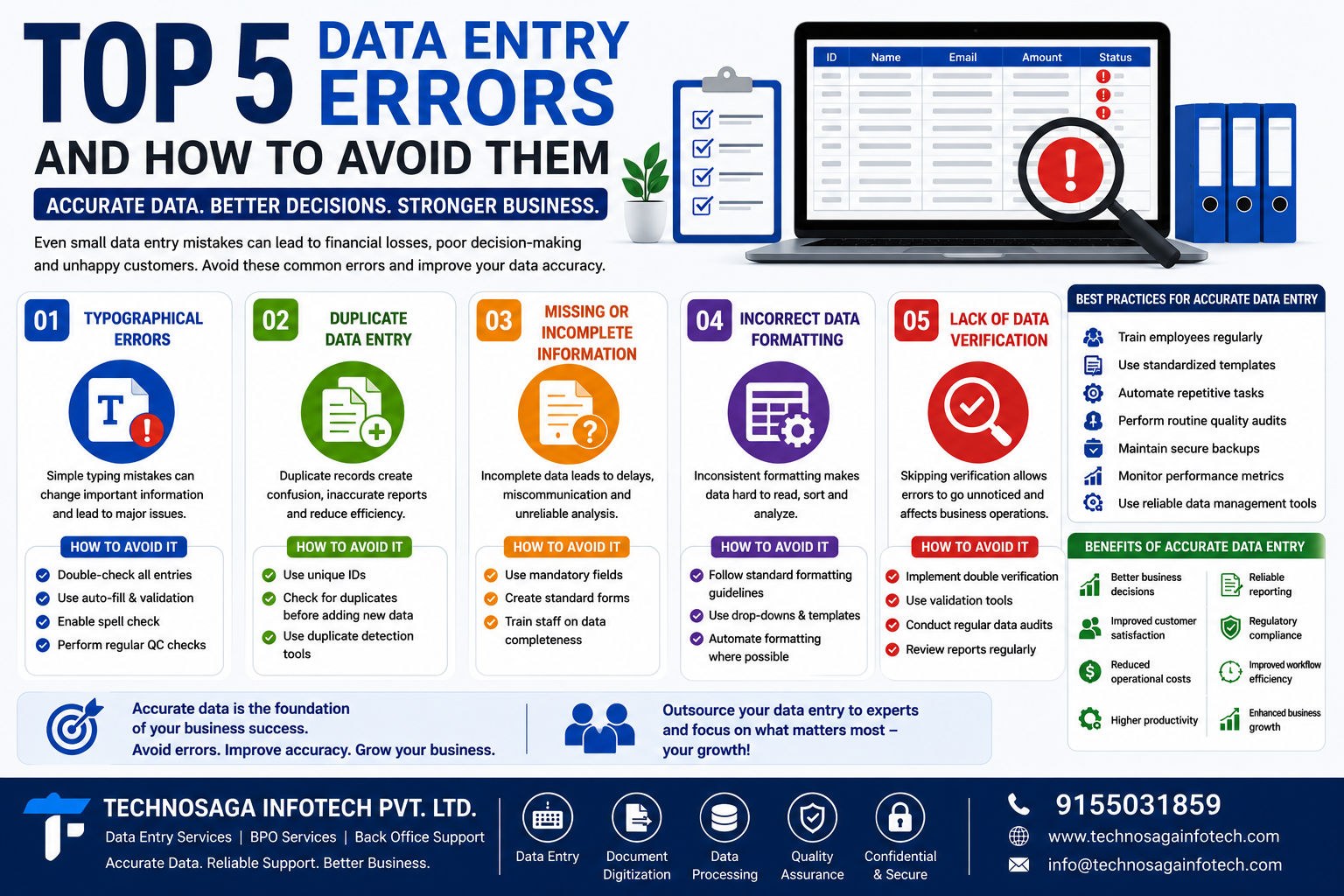
Top 5 Data Entry Errors and How to Avoid Them
Accurate data is the backbone of every successful business. Whether you're managing customer records, financial information, inventory, healthcare data, or government documents, even a small data entry mistake can lead to costly consequences.
Data entry errors can reduce productivity, affect business decisions, damage customer relationships, and even result in financial losses. Fortunately, most of these mistakes can be prevented with proper processes, training, and quality control.
In this blog, we'll explore the top five data entry errors businesses commonly face and practical ways to avoid them.
Why Data Accuracy Matters
Businesses rely on accurate data to make informed decisions. Poor-quality data can lead to incorrect reports, delayed operations, customer dissatisfaction, and compliance issues.
Maintaining accurate records helps organizations improve efficiency, reduce operational costs, and deliver better customer service.
1. Typographical Errors
Typing mistakes are among the most common data entry errors. A single incorrect number, letter, or symbol can completely change important information.
Common Examples
- Incorrect phone numbers
- Misspelled customer names
- Wrong invoice amounts
- Incorrect addresses
How to Avoid It
- Double-check entered information
- Use auto-fill where appropriate
- Implement validation rules
- Perform regular quality checks
2. Duplicate Data Entry
Entering the same information multiple times creates duplicate records that confuse reporting and reduce operational efficiency.
Problems Caused by Duplicate Data
- Multiple customer profiles
- Duplicate invoices
- Incorrect reporting
- Poor customer experience
How to Avoid It
- Use unique customer IDs
- Implement duplicate detection software
- Review records before adding new entries
3. Missing or Incomplete Information
Incomplete records often create delays in business processes and make data analysis unreliable.
Examples
- Missing email addresses
- Incomplete customer details
- Blank mandatory fields
- Missing transaction information
How to Avoid It
- Use mandatory field validation
- Create standardized data entry forms
- Train employees on data completeness
4. Incorrect Data Formatting
Inconsistent formatting creates confusion and makes it difficult to sort, search, and analyze information.
Examples
- Different date formats
- Mixed capitalization
- Inconsistent phone number formats
- Improper currency formatting
How to Avoid It
- Create standard formatting guidelines
- Use dropdown menus where possible
- Automate formatting through software
5. Lack of Data Verification
Many organizations skip the verification process to save time, resulting in inaccurate databases.
Without proper verification, small mistakes accumulate over time and negatively impact business operations.
How to Avoid It
- Implement two-level quality checks
- Use automated validation tools
- Conduct periodic data audits
- Review reports regularly
Best Practices for Error-Free Data Entry
- Train data entry professionals regularly
- Use standardized templates
- Automate repetitive tasks
- Perform routine quality audits
- Maintain secure data backup systems
- Use reliable data management software
- Implement access controls
- Monitor performance metrics
Benefits of Accurate Data Entry
- Better business decisions
- Improved customer satisfaction
- Reduced operational costs
- Higher productivity
- Reliable reporting
- Regulatory compliance
- Improved workflow efficiency
- Enhanced business growth
Why Businesses Outsource Data Entry Services
Many businesses choose to outsource data entry to experienced professionals rather than managing it internally.
Professional outsourcing partners provide trained operators, quality assurance processes, and scalable resources while allowing businesses to focus on their core operations.
If your business requires reliable data processing, document digitization, or back-office support, partnering with a professional BPO Company in Patna can significantly improve accuracy and operational efficiency.
Conclusion
Data entry may appear simple, but even minor errors can have a major impact on business performance. By implementing proper validation, standardization, employee training, and quality assurance processes, businesses can significantly reduce data entry errors.
Investing in accurate data management not only improves operational efficiency but also supports better decision-making and long-term business success.
Technosaga Infotech Pvt. Ltd. provides professional Data Entry Services, Document Digitization, Back Office Support, BPO Services, and Business Process Outsourcing solutions to help organizations maintain accurate, secure, and efficient data management.
```Facebook & LinkedIn don't allow pre-filled posts — clicking those buttons copies a ready caption to your clipboard, just paste it (Ctrl+V) into the box that opens.


Sabse pehle comment karne wale bane!