
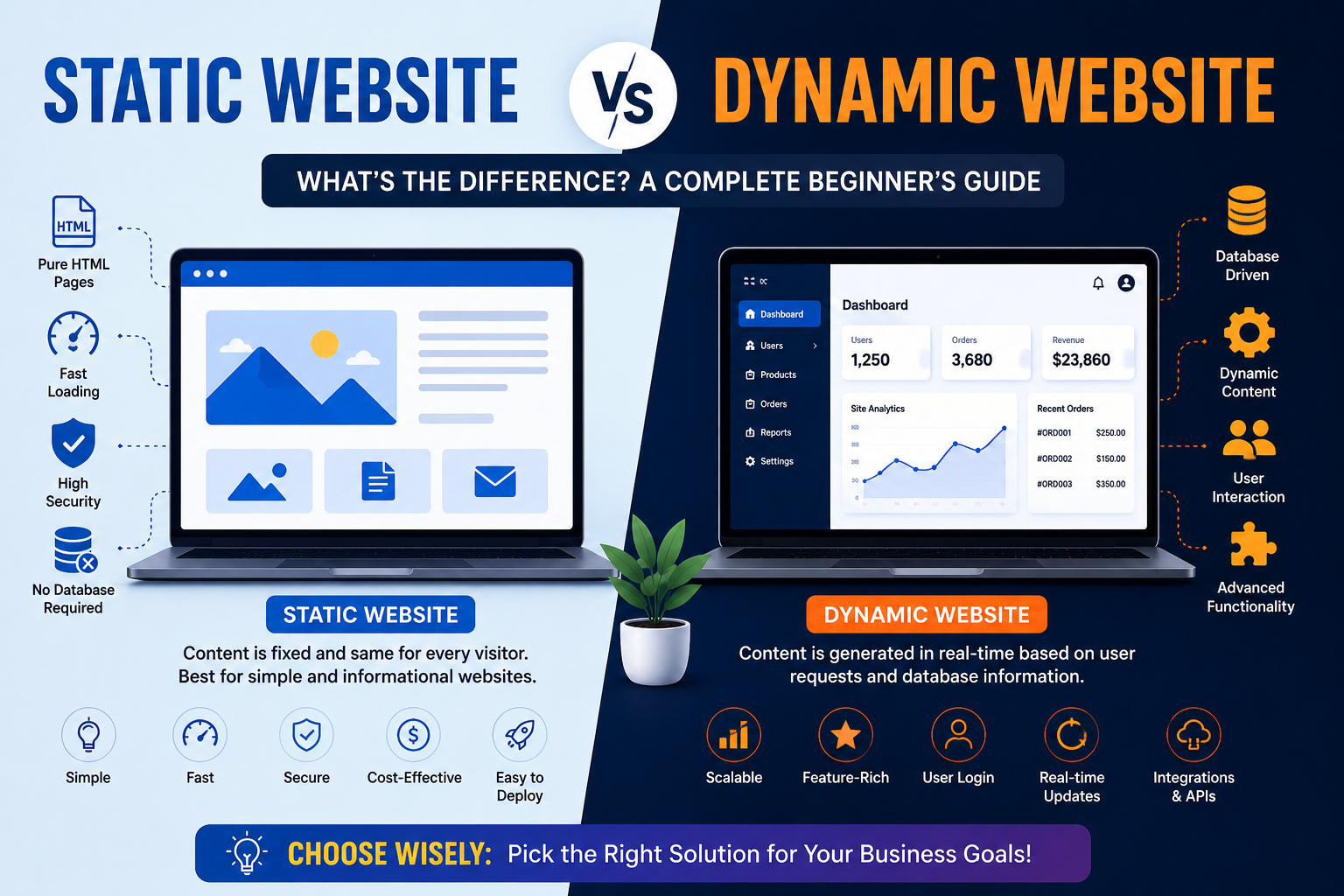
Static vs Dynamic Website: What's the Difference?
When planning to build a website, one of the first decisions you'll need to make is whether to create a static website or a dynamic website. Both types of websites serve different purposes and offer unique advantages depending on your business requirements, budget, and future goals.
Many beginners assume that all websites work in the same way. However, behind every website is a different architecture that determines how content is displayed, how users interact with the website, and how easily the website can be updated.
Understanding the difference between static and dynamic websites helps businesses make smarter decisions, reduce development costs, improve performance, and choose technologies that match their long-term objectives.
What is a Static Website?
A static website consists of fixed web pages that display the same content to every visitor. The content is stored directly in HTML files and remains unchanged unless a developer manually edits the source code.
Since the pages are pre-built, the web server simply delivers the requested HTML files to the user's browser without processing databases or server-side scripts.
Static websites are simple, lightweight, and ideal for projects where content rarely changes.
Examples of Static Websites
- Personal Portfolio
- Company Profile Website
- Landing Pages
- Event Websites
- Resume Website
- Product Showcase Website
- Small Business Website
- Digital Brochure Website
Key Features of a Static Website
- Fixed content for all visitors
- No database required
- Fast loading speed
- Simple hosting requirements
- Lower development cost
- Highly secure
- Easy deployment
- Limited interactivity
Advantages of a Static Website
Static websites offer several benefits, especially for individuals and businesses that need a simple online presence.
- Lightning-fast page loading speed
- Affordable development and hosting
- Excellent security due to no database connection
- Easy deployment using CDN services
- Minimal maintenance requirements
- Reliable performance under heavy traffic
- Ideal for SEO-friendly informational websites
Disadvantages of a Static Website
- Manual content updates required
- No user login functionality
- No database integration
- Limited scalability
- No personalized user experience
- Difficult to manage large websites
- Cannot easily support interactive features
What is a Dynamic Website?
A dynamic website generates content in real time based on user requests, database information, or business logic. Instead of serving fixed HTML pages, the server processes requests, retrieves data from databases, and creates pages dynamically before sending them to users.
Dynamic websites can display different content to different users depending on login status, preferences, location, or interactions.
Most modern business websites, eCommerce platforms, blogs, CRM systems, learning portals, and web applications are dynamic websites.
Examples of Dynamic Websites
- WordPress Websites
- E-commerce Websites
- News Portals
- Learning Management Systems (LMS)
- Hospital Websites
- School Management Portals
- Customer Portals
- Banking Websites
- Travel Booking Websites
- Real Estate Websites
Key Features of a Dynamic Website
- Database integration
- User authentication
- Content Management System (CMS)
- Real-time updates
- Interactive functionality
- Search features
- User dashboards
- Online forms and submissions
- Payment gateway integration
- API connectivity
Advantages of a Dynamic Website
- Easy content management
- Personalized user experience
- Supports unlimited pages
- Interactive functionality
- Scalable architecture
- Suitable for large businesses
- SEO-friendly when optimized correctly
- Supports third-party integrations
Disadvantages of a Dynamic Website
- Higher development cost
- Requires database management
- Needs regular maintenance
- More server resources
- Security monitoring required
- Longer development timeline
- Performance optimization needed
Static vs Dynamic Website: Quick Comparison
| Feature | Static Website | Dynamic Website |
|---|---|---|
| Content | Fixed | Dynamic |
| Database | No | Yes |
| Programming | HTML, CSS, JavaScript | PHP, Node.js, Python, Java, ASP.NET |
| Loading Speed | Very Fast | Moderate to Fast |
| User Interaction | Limited | High |
| Login System | No | Yes |
| CMS Support | Limited | Yes |
| Hosting Cost | Low | Medium to High |
| Maintenance | Low | High |
| Scalability | Limited | Excellent |
| Security | Very High | Depends on Implementation |
Technologies Used in Static Websites
- HTML5
- CSS3
- JavaScript
- Bootstrap
- Tailwind CSS
- Jekyll
- Hugo
- Gatsby
Technologies Used in Dynamic Websites
- PHP
- Laravel
- Node.js
- Python
- Django
- ASP.NET
- Java Spring Boot
- React.js
- Vue.js
- Angular
- MySQL
- PostgreSQL
- MongoDB
- WordPress
When Should You Choose a Static Website?
A static website is the best option when your website contains mostly informational content that doesn't change frequently. It is suitable for portfolios, landing pages, brochures, startup websites, event pages, and small business websites where speed, simplicity, and affordability are the top priorities.
When Should You Choose a Dynamic Website?
A dynamic website is ideal for businesses that require regular content updates, customer logins, online bookings, eCommerce functionality, dashboards, content management systems, payment gateways, or personalized user experiences. It is the preferred choice for growing businesses and enterprise applications.
Facebook & LinkedIn don't allow pre-filled posts — clicking those buttons copies a ready caption to your clipboard, just paste it (Ctrl+V) into the box that opens.
Sabse pehle comment karne wale bane!