
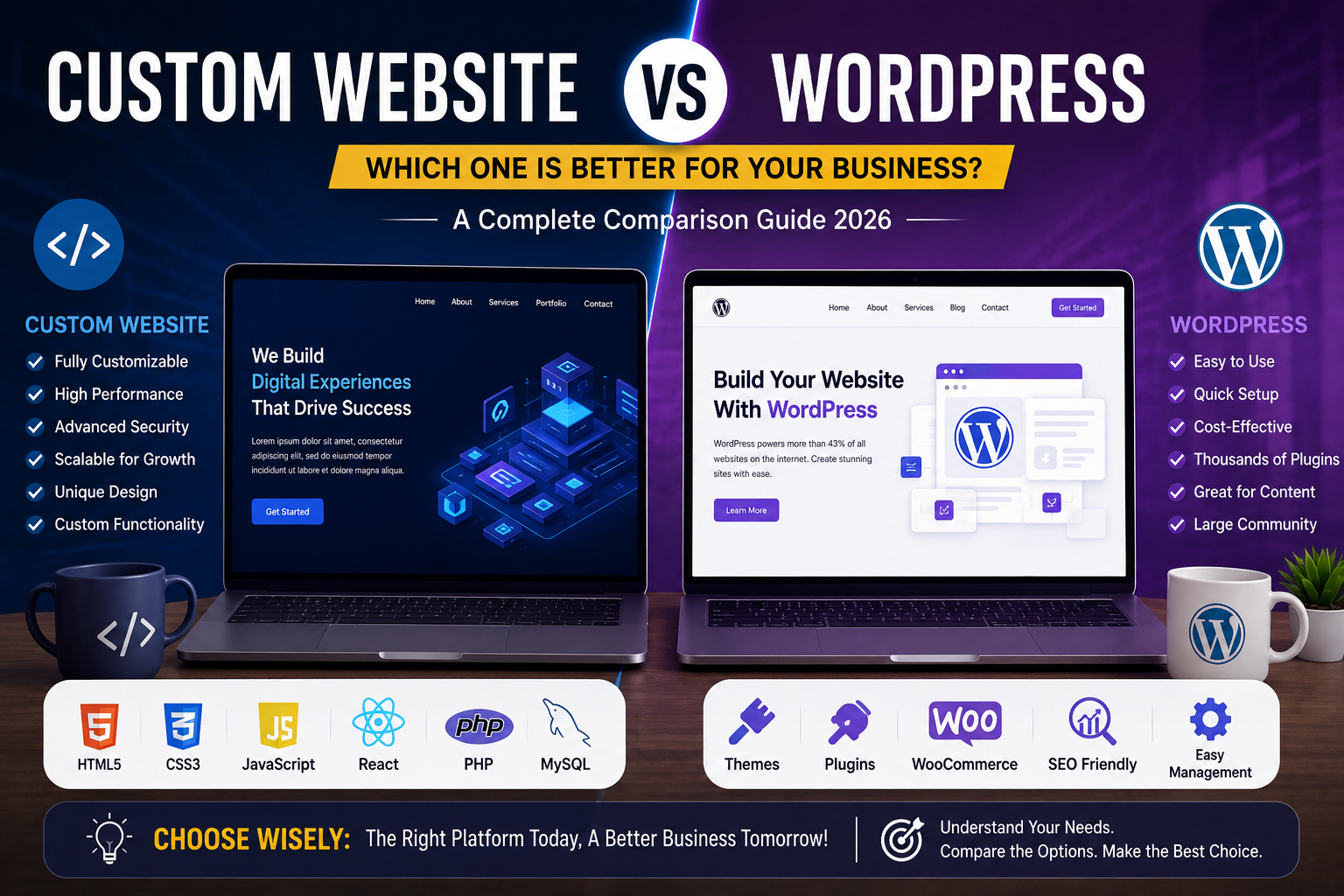
Custom Website vs WordPress: Which One is Better?
When planning a new website, one of the most common questions business owners ask is whether they should build a custom website or use WordPress. Both options are powerful, but they are designed for different business needs, budgets, and long-term goals.
WordPress is the world's most popular Content Management System (CMS), powering millions of websites due to its ease of use, affordability, and extensive plugin ecosystem. On the other hand, a custom website is built from scratch using programming languages and frameworks, giving businesses complete control over functionality, design, security, and scalability.
Understanding the differences between these two approaches will help you choose the right platform based on your business objectives rather than simply following trends.
What is a Custom Website?
A custom website is a website that is designed and developed specifically for a business or organization. Unlike template-based platforms, every feature, layout, workflow, and functionality is created according to unique business requirements.
Developers write custom code using programming languages, frameworks, and databases to create a website that perfectly matches business processes and future growth plans.
Common Technologies Used
- HTML5
- CSS3
- JavaScript
- Bootstrap
- React.js
- Vue.js
- PHP
- Laravel
- Node.js
- Python
- MySQL
- PostgreSQL
- MongoDB
Advantages of a Custom Website
- Unique design tailored to your brand
- Unlimited customization options
- Better performance optimization
- Higher scalability for future growth
- Advanced security implementation
- Custom integrations with third-party systems
- Optimized business workflows
- No unnecessary plugins or code
Disadvantages of a Custom Website
- Higher development cost
- Longer development time
- Requires experienced developers
- Maintenance depends on the development team
- Feature updates may require coding
What is WordPress?
WordPress is an open-source Content Management System (CMS) that allows users to create and manage websites without extensive programming knowledge. It provides thousands of themes and plugins that make website development faster and more affordable.
Originally designed for blogging, WordPress has evolved into a powerful platform capable of building business websites, portfolios, blogs, eCommerce stores, educational websites, and membership platforms.
Advantages of WordPress
- Quick website development
- User-friendly dashboard
- Thousands of themes
- Large plugin ecosystem
- Easy content management
- SEO-friendly structure
- Affordable development cost
- Large community support
Disadvantages of WordPress
- Plugin dependency
- Regular updates required
- Security risks if poorly maintained
- Performance may decrease with excessive plugins
- Limited flexibility for highly complex applications
Custom Website vs WordPress: Quick Comparison
| Feature | Custom Website | WordPress |
|---|---|---|
| Development | From Scratch | CMS Based |
| Customization | Unlimited | Moderate to High |
| Development Speed | Slower | Faster |
| Performance | Excellent | Good |
| Security | Very High | Depends on Maintenance |
| SEO | Excellent | Excellent |
| Scalability | Excellent | Good |
| Maintenance | Developer Required | Easy |
| Cost | Higher | Lower |
| Best For | Custom Business Solutions | Business Websites & Blogs |
Key Differences Between Custom Website and WordPress
1. Development Approach
A custom website is built entirely from scratch based on business requirements. Every feature, page, and function is coded specifically for the project.
WordPress, however, is a CMS that uses pre-built themes and plugins to accelerate website development.
2. Flexibility
Custom websites offer complete flexibility because developers can create any feature or workflow without being limited by existing plugins or themes.
WordPress provides flexibility through plugins, but highly specialized business requirements may require custom plugin development or significant modifications.
3. Design Freedom
Custom websites allow designers to create unique layouts that fully represent a brand's identity.
WordPress websites often begin with templates, although custom themes can also be developed to achieve a unique appearance.
4. Performance
Custom websites generally perform better because they contain only the code required for the project.
WordPress websites may become slower if they use too many plugins or poorly optimized themes.
5. Security
Custom websites have fewer publicly known vulnerabilities because they use unique codebases.
WordPress websites require regular updates to themes, plugins, and the core CMS to remain secure.
Who Should Choose a Custom Website?
- Large enterprises
- Startups with unique products
- SaaS companies
- CRM & ERP solutions
- Healthcare portals
- Educational platforms
- Marketplace websites
- High-traffic web applications
Who Should Choose WordPress?
- Small businesses
- Blogs
- Corporate websites
- Portfolio websites
- News websites
- Local businesses
- Freelancers
- Startups with limited budgets
Technologies Behind Both Platforms
Custom Website Technologies
- HTML5
- CSS3
- JavaScript
- React
- Vue
- Node.js
- Laravel
- Python
- MySQL
WordPress Technologies
- PHP
- MySQL
- HTML
- CSS
- JavaScript
- WordPress Core
- Plugins
- Themes
- WooCommerce
Facebook & LinkedIn don't allow pre-filled posts — clicking those buttons copies a ready caption to your clipboard, just paste it (Ctrl+V) into the box that opens.

Sabse pehle comment karne wale bane!